.svg)
The night before we started, I met an Ironman at the hotel bar. Veins like ropes, calves
carved from granite. His crew looked ready to bench-press the peak. They had summited
that morning. We toasted with Kilimanjaro beers, laughs echoing. Then he leaned forward,
his face suddenly serious. “That mountain? Brutal. Worst thing I’ve ever done.”
I heard him. But I didn’t believe him.
How bad could it really be?

I was supposed to climb Kilimanjaro a decade earlier. Back then, my body felt invincible,
injuries were temporary inconveniences rather than warnings. Then came the rugby
accident. Both ankles, broken. The trip, cancelled. The mountain, postponed indefinitely.
A decade later, I finally found someone to come with me. Not that it mattered much, we
hiked separately the entire time, each locked into our own rhythm, our own conversation
with the mountain. But at least I’d finally bitten the bullet. At least I was going.
The training had been brutal in its own right. Five days a week, two and a half hours each
session. Three continuous leg days. My body transforming itself into something I hoped
would be enough. Something that wouldn’t betray me again. I was careful now in ways I
hadn’t been before. Injuries were no longer abstract possibilities, they were ghosts that
followed me, whispering warnings.
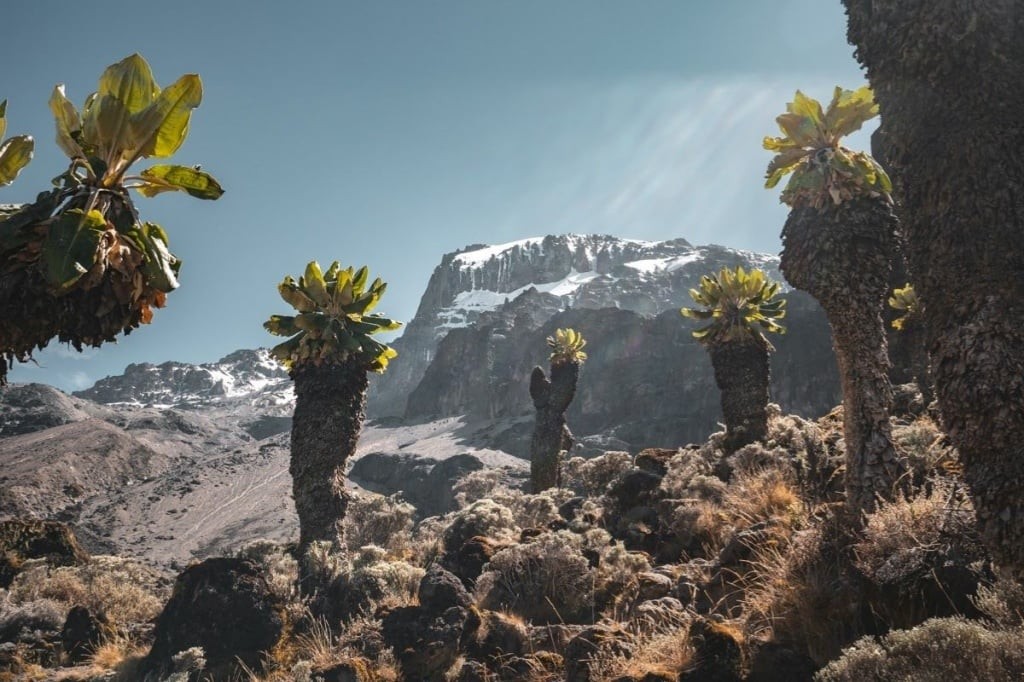
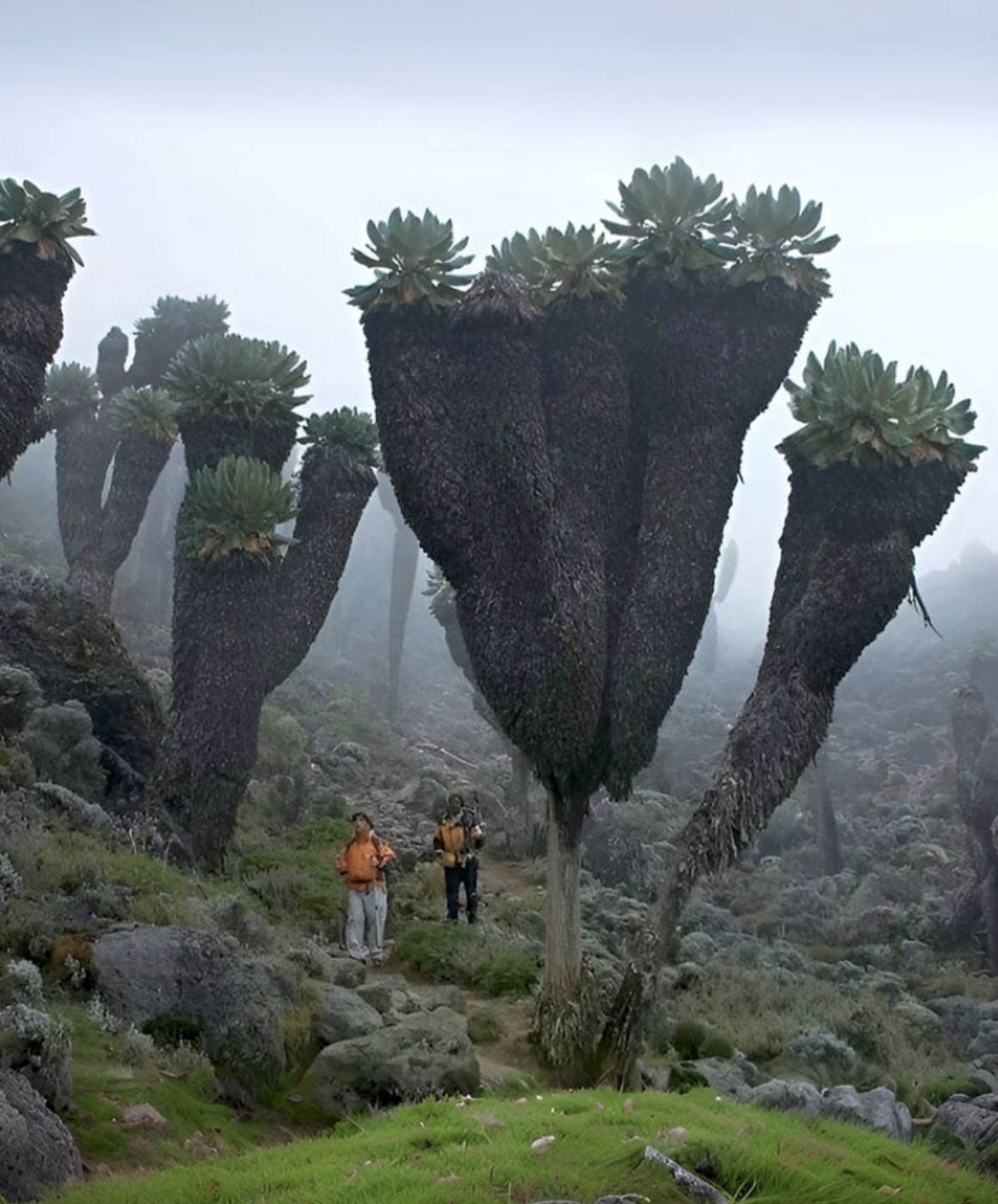
His name was Boka, my guide. Gentle. Patient. Knowledgeable about every flower and tree
we passed. On those first five days, as we moved through the mountain’s shifting
ecosystems, he’d point out species I’d never heard of, his voice soft with the kind of
knowing that comes from a lifetime lived in the presence of something vast.
Everyone we passed - every porter, every guide, every local, who belonged to this
mountain in ways I never could, offered the same greeting, the same instruction: pole pole.
Slowly, slowly.
In those early days, I heard the words without receiving them. I was already moving slowly,
or so I thought. My feet finding their rhythm, one step and then another, my breath steady,
my body holding strong. I felt good. Better than good. I was racing the porters to camp
each day and arriving barely winded. I hadn’t taken any Diamox, that altitude sickness
medication ninety percent of climbers rely on, and wore that fact like armour. Pole pole
seemed like advice for other people. For the ones already struggling. Not for me.
I didn’t yet understand that the mountain doesn’t warn the ones who are struggling. It
warns the ones who feel fine.
I wasn’t noticing the landscape, really. Not in the way you notice things when you’re trying
to notice them. I was just walking. All I saw were my feet moving, constant and sure.
LikeArjuna in the Mahabharata, I saw only the eye of the bird. Everything else fell away.
It reminded me of Thich Nhat Hanh’s walking meditation. Each step its own complete
action. Each breath its own world. For five days, I walked like this. For five days, the
mountain let me believe I was in control.
Just ten minutes before Camp 3, I sprained my ankle. Tears came fast, not from pain but
from memory. Objectively the sprain wasn’t debilitating. Trauma made it catastrophe. I
taped it, limped into camp, and the mountain watched.
The following night, we woke at eleven PM. An hour to gear up, force down garlic soup, re-
bandage my ankle, and make final checks. The pre-dawn cold was already seeping through
the tent walls. By midnight, we were moving.
The Ironman had been right, of course. But I wouldn’t know that yet.
Two hours in, I was still going strong. The bone-chilling cold, the howling wind, none of it
had touched me yet. My body was a machine. My training was paying off. I let myself feel
that pride, that satisfaction of preparation meeting challenge.
Then, somewhere around the three-hour mark, everything shifted.
It started as lightheadedness. Then my feet stopped falling quite in line with my intentions.
I have low blood pressure, have my whole life, and I know the warning signs. That strange,
urgent need to purge, to empty, that precedes blacking out. I’ve felt it before, that
particular harbinger of my body shutting down.
I felt it then, on the side of that trail, in the dark, with the summit still hours away.
I squatted right there. Barely two feet from Boka, darkness my only privacy. I peed. Then I
pooped. Asked for toilet paper. Cleaned myself. Stood up.
And nearly passed out.
What came next, I can’t fully explain.
I became a zombie. I threw up. Multiple times. But my legs kept moving. Kept shuffling.
Friends would later commend my mental strength, but that’s not what it was. I was too far
gone to summon mental strength. I was disassociated from my body entirely, watching
from somewhere outside myself as these legs (my legs?) continued their slow, relentless
shuffle forward.
It was pure muscle memory. The last few days of walking meditation. Of one foot in front of
the other. The days of training my body so thoroughly that it knew what to do even when I
was gone. My body walked without me. Snail-slow. Each step impossibly small. But the
steps kept coming.
Pole pole, everyone had said.
On summit night, when I could barely register language anymore, when I was more animal
than human, those words finally hit me like a brick. Pole pole. It wasn’t instruction. It was
permission. Permission to be this slow. Permission to take steps so small they barely
counted as movement. Permission to be gentle with myself when every cell wasscreaming.
Boka stayed close. Never touching, but present. Later I asked for feedback. He smiled.
“Listen to me next time.” I had spent five days proving strength, racing ahead. The
mountain wanted surrender.
Stella Point arrived like grace, and I mean that without metaphor. We stood above the
clouds, sunrise spilling gold and rose across an ocean of vapour, and something in me
broke open. I cried, relief and awe braided tight, but it was more than that. My heart was
too full for one emotion. Gratitude to God, to my body, to whatever force had carried me
through the night poured out of me all at once, wordless and complete. I had never felt so
small and so held at the same time.
But Stella was not the summit. Uhuru waited along the rim, close enough to see, far
enough to hurt. So we shuffled on, and there is no more honest word than shuffled, my
legs spent, my chest still burning with something that had nothing to do with altitude.
At the summit, I felt nothing like triumph. I felt quiet. Humbled.
On the way back down, as we descended through the mountain’s layers, through the
exhaustion and the relief and the strange, floating unreality of having survived something
you weren’t sure you’d survive, Baraka, the expedition leader, told me something that had
nothing to do with hiking.
He told me it was common in Tanzania for men to marry women who already had children
from another relationship. And these Tanzanian men, he said, would accept the children as
their own so completely that the child would never even know their father was technically a
stepfather.
I sat with that for a long time. In my culture, this would be unusual. In my world, the lines
between “yours” and “mine” are drawn more sharply. But here, on this mountain, in this
place where strangers had carried my belongings and guided my steps and held space for
me at my most vulnerable, the boundaries of care seemed more porous. More expansive.
Maybe that’s what the mountain teaches, in the end. Not just about physical endurance,
but about what it means to be carried. To be held. To let go of the story that you’re doing it
alone.
I’m home now. My body is exhausted. There’s a post-climax malaise, a flatness after
intensity. I haven’t felt like pushing myself. Haven’t wanted to.
But I’m grateful to this body, grateful in ways I wasn’t before. Grateful that it holds me
through things I don’t think I can survive. Grateful that it learned, through hours and hours
of training, what to do when I couldn’t tell it anymore. Grateful that it carried me when I
was gone.
The mountain took everything I thought I knew about strength. About control. About what
it means to summit, to succeed, to push through.
And in return, it gave me this: the knowledge that sometimes the only way forward is so
slow it doesn’t feel like moving at all. That preparation isn’t about being strong enough toconquer,
but about training your body to remember when your mind forgets. That being held - by a guide,
by muscle memory, by the permission to move slowly, isn’t weakness.
It’s the only way through.
Pole pole, they said. Slowly, slowly.
I finally understand.