.svg)
Before Theory of Slow existed, I spent time working with Kiran. Through her thoughtful questions, clarity, and unwavering presence, she helped me reconnect with my own inner compass and find the momentum to take the next steps.
Kiran’s work is rooted in helping women come back to themselves—through the body, through lineage, and through the deeper intelligence that often goes unheard in the noise of everyday life. As a conscious leadership coach, she brings a grounded lens to feminine awakening, inviting women to lead from clarity and their inner truth.
What has always stood out to me is the sincerity behind her path: her commitment to her own practice, her connection with her roots, and the humility with which she speaks about growth. This feature is a chance to step behind the framework of her offerings and understand the real journey that informs them—the breakdowns, the rituals, the teachings, and the spaces that shaped her into who she is today.

Q. Can you recall the first moment you truly recognized the feminine as a living force in your life, and how did it influence your relationship with the feminine wisdom you carry today?
A. Thank you for this question. It’s beautiful to look back in this way because it reminds me that she was always there.
There are a few standout moments. When I was 19, I met a sincere, enlightened Himalayan Master who travelled the world teaching meditation rooted in Kashmiri Shaivism. That encounter, and the years of practice that followed, marked a profound feminine awakening. I fell in love with Her—the Divine Mother.
This was the phase when I began to know Her through ritual and culture, though not yet in all aspects of my life. There was still a fragmentation. At the time, I was a lawyer—anxious, disconnected from my body, and carrying very little clarity about my path. Yet as someone reflected back to me then, whenever I sang or meditated, the Mother came. I was devoted to these practices, and there was a grace quietly integrating in the background.
That period led to a series of unexpected leaps into the unknown: moving to Kenya, calling in a job that deeply supported that chapter of my life, and eventually pursuing coaching certifications simply because I felt drawn to them.
The next significant moment came when I felt called to coach full-time. Without a boss or external structure, it became impossible to ignore how deeply I had internalised a hyper-masculine way of moving through work and life. I could see how much force, striving, and scarcity were shaping my decisions. That recognition sparked another layer of awakening.
Alongside my spiritual practices, I began working with my female nervous system and exploring feminine wisdom not only as devotion, but as a way of being. I started learning how to trust my body, listen more deeply, and relate differently to life.
The shift—which continues to deepen—is an anchoring in the body, in self-trust, and in receptivity. It has allowed me to stop grasping, striving, and forcing, and instead let my business and life unfold in ways that feel true. There is something incredibly nourishing about returning to our native state as embodied abundance, and I continue to experience deeper access to that feminine remembrance.
Q You often speak of India with a sense of reverence and belonging. Are there particular places, people, or landscapes that have shaped your becoming—spaces that continue to call you back to yourself? What have they revealed about the feminine that can only be learned through presence, relationship, and lived experience?
A. Yes, my journey India gives me an undeniable grace like nothing else. A simple and profound part of this I believe is that your ancestral land has something for you if you are receptive to it. There is a homecoming and access to parts of self that comes from simply being in India with reverence (and my trip to Pakistan too), it takes no effort on my part. It’s swimming in a river or a morning walk and something is anchoring. I feel this the most when I go to Ganeshpuri, a little village outside of Mumbai where the root of my spiritual lineage began (the teacher I met when I was 19 learnt here).
You’re right to recognise that these trips are beyond a book, course or training. I think any place where there are wisdom keepers who are preserving ancient ways of being (actually knowing how to village) and tending to altars in ways that draw out the potency of sacred spaces are so, so transformative.
At the same time, it’s easy to miss. Access often comes through the right people, places, and practices. But when those doors open, the experience becomes layered: the pull of the motherland, the continuity of ritual, the presence of wisdom keepers, and the act of being in practice yourself. Together, they create a kind of receiving portal.
There is so much of Her grace overflowing in India. And there is also a trickster energy woven through it all—which means the invitation is not only to arrive, but to pay attention.
Q. Looking back, was there a breakdown, breakthrough, or pivotal moment that fundamentally changed your relationship with your path? How did that journey reshape your understanding of power, moving it from something measured by achievement and output to something rooted in embodiment?
A. Part of my own maturation process has been moving away from the idea that a single breakthrough is going to change everything and instead recognising that the process is the point.
If I had to name a defining lesson, it would be seeing how deeply we neglect and under-resource ourselves as women by remaining attuned to everyone else or trying to perpetually be the good girl. If you recognise yourself in this, I want you to know that it’s natural. The female nervous system is highly sensitive to the social nervous system, and so much self-abandonment happens unintentionally through looking outward rather than turning inward.
Coming back to ourselves requires practice. It asks us to open to receiving, cultivate yin energy, and learn to attune to our own needs, desires, and voice.
I also think many of us mistake productivity for power because we’ve lost touch with the power of our own beingness. The first step is recognising where you are trying to earn love, validation, or worth through what you produce. The more deeply you anchor into your inherent power, the less compelled you are to prove yourself at any cost. Over time, you begin to see just how extractive that striving can be.
One of the most transformative practices for me has been building a relationship with my menstrual cycle. It has taught me to surrender to a different understanding of consistency—one that is rooted in listening to my body rather than adhering to a rigid standard of productivity. That shift has changed not only how I work, but how I relate to myself.
Q. You often speak about embodiment as a source of wisdom and abundance. How has your relationship with your body evolved as a guide on your path? What does embodied abundance actually feel like for you? As someone who holds space for others, how do you honour those signals while remaining open and receptive to the world around you?
A. Embodied abundance is the somatic experience of anchoring into your innate nature as abundant and creational. It’s the felt sense that life, God, the earth, and your own nature want to pour into you—if you are open to receiving.
Everyone’s experience of this is different. For me, it feels like a deep fullness and satiation, a sense of being profoundly met and nourished by life itself. I believe this is something many women crave, but have forgotten how to access. From that place, embodied abundance begins to shape our relationship with everything—our bodies, money, partnerships, leadership, and the sacred.
Because every woman’s system is unique, I often guide the women I work with through the language of their own bodies so they can recognise their particular yes and no. A simple place to begin is by recalling a moment of deep alignment and noticing how it felt in your body. Then bring to mind a moment of dissonance and notice the difference.
For me, misalignment often shows up as a subtle uneasiness or a scrambling of the mind. Once I recognise it, I can slow down and listen for what is creating that contraction. But at the heart of my work is nourishment. While discernment is important, I am ultimately more interested in helping women strengthen their yes—to open themselves to receiving life so fully that many of their no's reveal themselves naturally.
It takes practice to remain open while not carrying everyone else's experience as a facilitator. Part of that comes with time, but two things have been especially important for me. The first is trust. I trust the women I work with. I am not trying to save them or carry their process for them. Again and again, women tell me that this trust feels palpable, and that it supports them in stepping into their own leadership.
The second is my relationship with my body. Anchoring more deeply in the womb and the female nervous system has made me more sensitive in many ways, but also far more resilient. It takes much more to dysregulate me now. I have found that somatic practices tailored to the female nervous system expand our energetic capacity, and for that I am deeply grateful.
And finally, I am always receiving support myself. Having spaces where I can be held and guided helps me stay grounded and ensures that my work remains integrous.
Q. Looking back, what are the quiet influences that have shaped you most deeply? Perhaps it's a small, almost invisible ritual woven into your daily life, or a book, scripture, or teaching that fundamentally changed the way you see yourself, the feminine, or the world. What continues to stay with you from those encounters?
A Something about me, I love ritual. I love serving at my altar with all the works, not because I have to but because I love it, it’s so fun for me. But if I were to pick something small it would be a practice of contentment. A question I am always asking myself is ‘what is already working?’ or ‘how am I already receiving?’ - this practice of receiving what is really helps me cut through perfectionism and is such a vibrant cornerstone of opening to more.
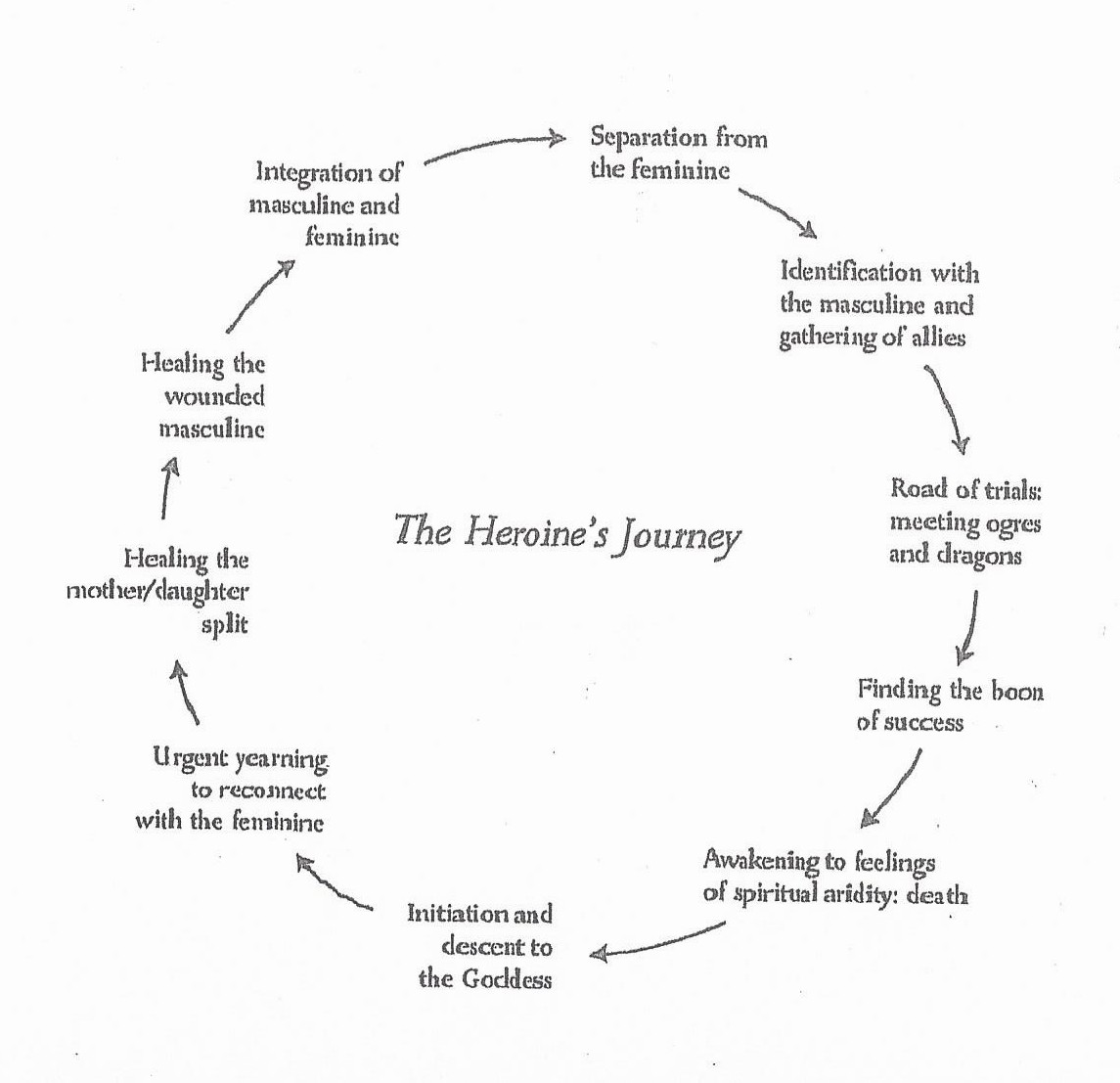
There is a frame from the Heroine’s Journey by Maurine Murdock which I share often in my work because I find this arc to be accurate and illuminating and has given me a really useful map to give language to what a lot of women are experiencing and to redirect to a homecoming and meet yourself in your process.
Q Through your work with women across different cultures and contexts, what patterns do you see emerging again and again? Do you sense a collective fatigue around achievement, striving, and constant doing, and if so, how is this showing up in the bodies, relationships, and lives of women today? And as women begin to heal and reconnect with themselves, how do you see that transformation rippling outward into families, communities, and the collective?
A. I often see the ways women—myself included—have become profoundly under-resourced and oriented toward neglecting ourselves. This can show up as an inability to trust ourselves or fully commit to our authentic vision for our lives and work. It can look like people-pleasing, moving between the roles of victim and saviour, or resisting the very things life is asking of us.
Women often come to me carrying a dream they’ve held for years, yet they either cannot act on it or are pursuing it in ways that are deeply extractive and unsustainable. Beneath so much of this is a disconnection from self and a lack of nourishment.
I carry a visceral sadness around the collective fatigue I see in women and the havoc it is creating in our bodies, lives, and communities. We are the generation that was told we could have it all, but somewhere along the way many of us lost touch with our rhythms. We forgot how to move from our wisdom, how to attune, track, and listen.
The consequences are everywhere. Some women are anxious, some burnt out, others chronically unwell. We see it in rising rates of exhaustion, loneliness, dissatisfaction, reproductive health challenges, and autoimmune conditions. At its root, I believe much of it stems from a profound disconnection from the body and from our true nature.
And yet, I also feel hopeful. The feminine is rising because more and more women have had enough. They are beginning to return to a baseline of inherent worth and are finding the courage to do the inner work that truly nourishes them.
I believe that work is far bigger than the individual. We are deeply interconnected, and when a woman comes back into right relationship with herself, the impact ripples outward—to her relationships, her community, and the collective consciousness we are all shaping together.
Q. When you imagine a future defined by embodied leadership, what does it look and feel like? What becomes possible when women lead from devotion, body-wisdom, and wholeness?
A. I often wonder whether we will see the full fruits of this work at a collective level within our lifetime. I’m not sure.
What I have witnessed are profound shifts in individual lives—women calling in long-held desires, whether that’s a child, a home, a relationship, a business, or greater financial abundance, all while centering the feminine. But honestly, much of the transformation is far more subtle than that. It’s women feeling more at peace. More sensually alive. More coherent, vital, and at home in themselves rather than at odds with systems that were never designed to support them.
My hope is simply that more people get to experience this. There is a lightness that comes from living in this way—a deeper sense of vitality, presence, and belonging.
Perhaps one day it will become the norm. The result, I imagine, is a world where people feel more connected to themselves, to one another, and to the natural world. Sometimes I catch glimpses of it. It’s the feeling that arises when you sit quietly in an art gallery or a rainforest and sense that everything is alive, pulsing with an intelligence and life force far greater than your own.
The more women who say yes to the journey toward their own wholeness, the more possible it becomes for us to remember our true nature and live from that place, rather than drift further away from it. I just want women to know their power and to have standards that reflect that.
In the meantime, I get the honour of witnesses those who are anchoring feminine wisdom into their reality in powerful ways. I get to work with sensitive visionaries and creatives who are birthing bodies of work and businesses while being incredibly nourished. Businesses that are regenerative (including for them as leaders) rather than extractive. And in that I get to witness women come home — to her body, her desires, her knowing, her relationship with the Divine, and the feminine wisdom that has been waiting for her all along by actualising her creative dreams.